The Psychological Side of Hair Loss
Hair loss does not just change how you look. It changes how you feel about yourself, how you move through the world, and how much mental energy goes into something most people never have to think about. This guide is honest about the psychological impact — and honest about what actually helps. From Mark Terrell at ScalpLiners, who’s been through it himself.
You know how it starts. The mirror on a bad morning. The group photo where you’re positioned at the back, not quite by accident. The way you tilt your head in selfies now. The deliberate choice of certain seats in certain rooms so the light doesn’t catch the top of your head the wrong way.
The avoidance starts small and then quietly colonises your life. You stop suggesting swimming holidays. You wear a cap more than you used to. You find yourself on the side of the pavement where the shadow falls in your favour. None of it is dramatic. None of it would look significant to anyone from the outside. But from the inside, the mental overhead is constant and exhausting.
This is not weakness. This is not vanity. This is the lived experience of millions of men and women who are dealing with something that hits at a very core part of how people relate to their own identity. Hair loss carries enormous cultural weight — it is associated with ageing, with loss of control, with the end of something. And the cruelest part is that it happens gradually, so you never quite get to make peace with it before it moves further on.
If any of this sounds familiar, this guide is for you. Not to give you a sales pitch — but to take the psychological reality of hair loss seriously, and to give you honest information about what helps.
The psychological impact of hair loss is not just anecdotal. It has been the subject of serious academic study, and the findings are consistent: hair loss causes measurable, significant reductions in quality of life, self-esteem, body image and social confidence — in both men and women.
A 2012 study published in the International Journal of Trichology found that among women with hair loss, 88% reported reduced self-confidence, 75% said it had affected their social life, and 50% reported anxiety and depression as a direct result. These are not trivial numbers.
Research on men consistently shows that the psychological impact of hair loss is often disproportionate to the degree of loss — meaning that men in the earliest stages of thinning frequently report greater distress than men who are more extensively bald. The uncertainty of the early stages, the watching and waiting, the not knowing how far it will go — this appears to be psychologically harder than the stability of advanced loss.
A well-cited study from the Journal of the American Academy of Dermatology found that men with alopecia areata (patchy hair loss) scored significantly lower on quality of life measures compared to men without hair loss, at levels comparable to serious chronic skin conditions. The burden is real and it is measurable.
What is also documented, however, is that effective treatment — whatever form that takes — produces equally measurable improvements in self-esteem, body image and quality of life. The psychological burden of hair loss is not something people simply have to accept. It can be lifted.
Before talking about what genuinely helps, it is worth being honest about what doesn’t — because the market for hair loss is full of products and behaviours that provide short-term relief while quietly making the long-term situation worse.
Wearing a hat is not a problem in itself. Many people wear hats all their life and it means nothing. The problem is when the hat becomes a psychological crutch — when you feel anxious or exposed without it, when you won’t go certain places without it, when it starts dictating your life in ways you can feel but haven’t quite admitted to yourself. The hat becomes a comfort behaviour that reinforces the belief that your hair loss is something to hide, something shameful, something that other people will judge. That belief deepens the anxiety, rather than resolving it.
Products like Toppik, Nanogen and similar keratin fibre concealers can be genuinely effective for a photograph or a one-off occasion. But daily use creates its own particular kind of stress. The constant checking whether it’s still in place. The anxiety about wind or rain. The carefully staged morning routine that has to happen before you feel ready to leave the house. The fear that someone will notice. The relief when nobody does, followed by the same process tomorrow.
This is not a solution. It is a daily management of anxiety that keeps you in a cycle of avoidance and concealment rather than ever feeling genuinely settled. Many clients who come to ScalpLiners have been using fibres for years and describe the freedom of being able to just — leave the house — as one of the most unexpectedly significant changes after SMP.
The combover. The strategic sweep. The hair product regimen that adds just enough volume to not quite hide what’s there, requiring a specific drying technique that takes twenty minutes every morning. Again, not a problem in isolation. But when the hairstyle is load-bearing — when your whole sense of how presentable you are depends on it staying exactly right throughout the day — it becomes another source of ongoing low-level stress rather than a solution to it.
The common thread through all of these is that they address the surface of the problem while preserving the underlying anxiety. What actually helps does one of two things: changes your relationship with the hair loss (acceptance), or changes the reality of the hair loss (action).
Real acceptance — not resignation, not giving up, but genuine peace with how you look — is probably the most psychologically healthy response to hair loss. If you can genuinely arrive at that place, you will be better off than any treatment can make you. Some people do. They shave their head, they stop giving it mental space, they get on with things.
If you are reading this article, you may not be in that place yet — and that is completely valid. Acceptance cannot be forced. Telling someone with hair loss anxiety to “just embrace it” is about as useful as telling someone with depression to “just cheer up.” The advice is technically correct and practically useless. Forced acceptance often becomes suppression, which is actually worse for long-term wellbeing.
If acceptance is something you want to work towards, therapy — particularly cognitive behavioural therapy (CBT) or acceptance and commitment therapy (ACT) — can genuinely help. These approaches work on your relationship with your self-image rather than trying to change the image itself, and the evidence base is solid. Your GP can refer you or you can access therapy privately.
For many men, the proactive decision to shave the head is genuinely transformative. Rather than watching the hairline retreat millimetre by millimetre, you take control. You make a choice. Research from the University of Pennsylvania found that men with shaved heads were perceived by others as more dominant, more confident and even taller and stronger than the same men photographed with thinning hair. The psychology is clear: a shaved head reads as a deliberate choice, not a loss.
The challenge for some men is that a shaved head without much natural shadow can look pale or patchy against certain skin tones, or can draw more attention to an uneven scalp shape. This is where SMP becomes a natural companion — read more in the section below.
If you are wondering whether you are at the stage where shaving makes sense, the guide on going bald and understanding your options covers the Norwood stages and when different approaches are typically most effective.
Minoxidil and finasteride are the two evidence-based medical options for slowing or halting pattern hair loss. They can provide real psychological benefit for men in the early stages — not just by potentially slowing the loss, but by providing a sense of agency and action. Doing something that might help is often psychologically better than doing nothing.
The important caveat is expectation management. Neither medication reverses established hair loss. Neither guarantees the hair you have now will still be there in five years. They are a delaying action, not a cure. For men who have already lost significant density, or who want a permanent and certain outcome, medical treatments are unlikely to deliver the confidence shift they are hoping for.
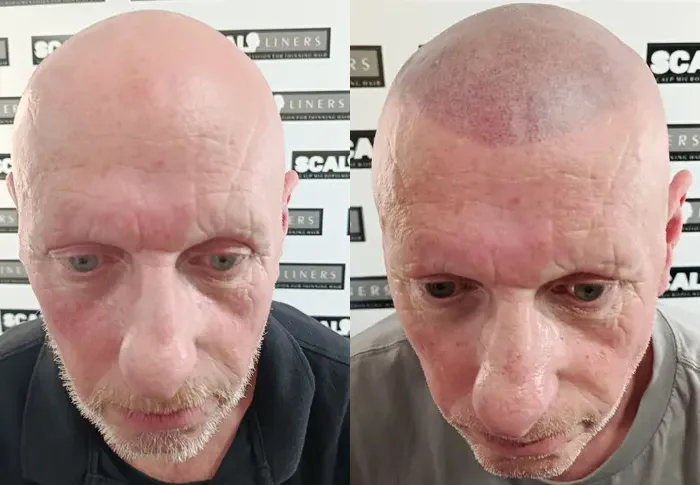
SMP is not just another hair loss treatment to compare on a spreadsheet. It operates on a different level. It does not try to slow, stop or reverse hair loss. It changes what you see in the mirror. Completely. Immediately. Permanently.
The process deposits specialist pigment into the upper layer of the scalp, replicating the look of hair follicles with precision. The result is the appearance of a close-cropped, full head of hair — or, for those with remaining hair, visibly thicker and denser coverage. It is completed across 3 sessions. It requires no ongoing medication, no daily routine, no maintenance beyond normal sun protection. The results last 4–7 years before a light refresh is needed.
What makes SMP particularly significant in the context of confidence is not just the visual outcome — it is the mental load that it removes. The fibres are gone. The cap is optional rather than obligatory. The twenty-minute hair routine that was really an anxiety routine is gone. You can get in the sea. You can stand in the rain. You can be in a photograph without planning the angle first. The small, constant, grinding preoccupation with how your head looks just — stops.
See real client results from ScalpLiners to understand what the outcome actually looks like, or visit the pricing page for a clear breakdown of what SMP costs — from £250 including all 3 sessions and a 12-month guarantee.
"For years I arranged my whole life around not being seen in certain situations. Tilting my head in photos. Choosing where to sit based on the lighting. It sounds ridiculous when I say it out loud. After my SMP, the thing I noticed most wasn’t actually how I looked — it was how much mental space opened up when I just stopped thinking about it. I genuinely forgot to worry. I hadn’t done that in a decade." — Mark Terrell, ScalpLiners
For people dealing with alopecia areata, totalis or universalis, the psychological impact can be even more severe — particularly because the loss is often sudden, unpredictable, and carries visible signs that are harder to minimise. The patchy nature of areata in particular can be more distressing than uniform loss, because it reads as “something wrong” to observers in a way that a receding hairline often doesn’t.
SMP for alopecia works by creating a uniform, controlled appearance across the affected areas — turning patchy, unpredictable loss into a clean, deliberate look. Many alopecia clients describe it as reclaiming the narrative around their appearance. You are no longer someone with “a condition” — you are someone who looks exactly how they choose to look.
Read the full guide to SMP for alopecia in Kent for more detail on how the treatment works for different types of alopecia.
If you are considering SMP — or just curious about whether it could help your specific situation — the consultation with Mark at ScalpLiners is genuinely free and genuinely pressure-free. That is not marketing language. It is the way Mark runs things because he was in this position himself and he knows what kind of conversation he needed.
You can message on WhatsApp with questions. Send a photo if you want an initial sense of what SMP would look like for your situation. Ask anything — about the process, the cost, whether it would work for your hair type, how it would look in five years. There is no script, no pitch, no upselling. Just a straight conversation with someone who has been through hair loss personally and has now spent years helping other people through it.
Mark trains as an SMP practitioner because he wanted to give people the outcome he had himself — not just a better looking head, but the thing underneath that. The freedom to stop thinking about it.
If you want to understand more about Mark’s background and how ScalpLiners came about, the about page covers it. If you are still in the early stages of understanding your hair loss, the guide on Am I Going Bald? is a useful starting point.
This guide is not a sales pitch and it is not trying to push you towards any particular action. If you are someone who is going to find your way to genuine acceptance — that is the best possible outcome and SMP will not do anything for you that you couldn’t do for yourself.
But if you have been managing hair loss anxiety for months or years, quietly arranging your life around it, and you haven’t actually looked seriously at permanent solutions yet — then this might be worth a thirty-second WhatsApp message. Not to commit to anything. Not to pay for anything. Just to have a conversation with someone who understands, get some information, and see how you feel.
That is all the consultation is. A chat. No pressure.
Common Questions
Just a Chat. No Pressure.
Mark has been through hair loss himself and built ScalpLiners because of it. He will listen, answer honestly, and tell you exactly what he would do in your situation. No script, no upselling, no obligation. If you just want to ask a question — send a message. That’s genuinely all it takes. SMP from £250 including 3 sessions and a 12-month guarantee.
Keep Reading