Understanding Hair Loss
The early signs, what causes it, how fast it progresses, and what your genuine options are — at every stage. An honest guide from ScalpLiners, Whitstable, Kent.
It usually starts quietly. You notice more hair in the shower drain than usual. The light catches the top of your head at an odd angle in a photo. Your hairline looks just slightly further back than you remember it being. You find yourself checking more often. Angling your phone for a better look. Googling things at 11pm that you wouldn’t admit to searching for in the morning.
That low-level anxiety is something most men go through alone — and completely unnecessarily. Hair loss is extraordinarily common, well understood, and there are real options for dealing with it at every stage. The first step is simply knowing what’s actually happening.
"I noticed mine in my late twenties. I didn’t talk about it — I just started avoiding certain lights, certain photos. It took years before I actually did anything about it. I wish I’d had someone tell me early on: this is normal, here are your options, here’s what actually works." — Mark Terrell, ScalpLiners
Male pattern baldness (androgenetic alopecia) has a recognisable pattern. It doesn’t happen randomly — it follows a predictable sequence driven by genetics and hormones. The early warning signs to look for:
Not all hair loss is male pattern baldness. Sudden or patchy loss, loss in unusual areas, or loss accompanied by itching, scaling or discomfort can indicate other conditions (alopecia areata, scalp psoriasis, thyroid disorders) that warrant a GP visit. True male pattern baldness is gradual, diffuse and follows the Norwood pattern.
The Norwood scale is the standard classification system for male pattern baldness, developed in the 1950s and refined in 1975. It runs from Type I to Type VII:
Early Stage (I – III)
Advanced Stage (IV – VII)
Most men who notice early signs are at Norwood Type II or III. This is the ideal time to evaluate your options — while there is still the most to work with, if you want to try to slow the progression.
The primary driver of male pattern baldness is dihydrotestosterone (DHT) — a hormone derived from testosterone by the enzyme 5-alpha reductase. In men with a genetic predisposition, hair follicles on the top and front of the scalp are sensitive to DHT. Over time, DHT binds to receptors in these follicles, causing them to shrink (miniaturise), produce finer and shorter hairs, and eventually stop producing hair altogether.
The follicles on the sides and back of the head are typically DHT-resistant, which is why male pattern baldness follows the characteristic Norwood pattern rather than affecting the whole head evenly.
Other contributing or compounding factors include:
This varies widely between men and is one of the most difficult things to predict. Some men lose hair rapidly in their 20s and then stabilise. Others notice slow, steady progression over decades. The rate of loss at the start is generally — but not always — indicative of the long-term trajectory.
If you’re in your 20s and noticing hair loss, it can feel more alarming because the contrast with peers is greater. But it is common, and the earlier you identify it the more options you have.
Your options broadly fall into three categories: slow it, replace it, or reframe it with SMP.
If you are in the early stages (Norwood II–III), finasteride or minoxidil may slow or halt the progression and even prompt some regrowth. Finasteride in particular has strong clinical evidence. The commitment is lifelong daily use — stopping will reverse any gains. Neither is a cure, and neither works well on established bald areas.
A hair transplant can restore density to thinning areas using your own donor hair. This is a significant financial and time investment (£3,000–15,000+, 12–18 months for results) and is not suitable for everyone depending on the extent of loss and donor hair availability.
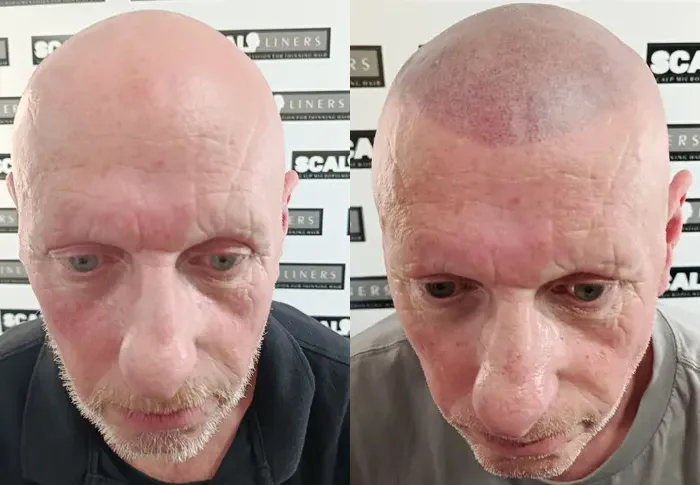
Scalp micropigmentation does not slow hair loss or regrow hair — it replicates the appearance of a full, closely shaved head by depositing specialist pigment into the scalp. It works at Norwood II and at Norwood VII. It can subtly reinforce a receding hairline so changes become barely noticeable, or it can cover a completely bald scalp to look like a fresh grade 0 shave.
Crucially, SMP does not require active follicles. It does not depend on whether your hair loss slows or continues. If it does continue, a simple top-up session extends the treated area. There is no waiting for results — the change is visible from session one.
For men who are in their 20s or 30s and noticing the first signs, SMP is an option worth understanding early. It means you never have to reach a point where you feel you’ve lost control of how you look.
Mark at ScalpLiners has been through this personally — the noticing, the worrying, the experimenting, and eventually finding something that genuinely worked. He trained as an SMP practitioner because of his own experience, not despite it.
The free consultation at ScalpLiners is 30 minutes. There is no pressure and no sales pitch. Mark will look at your scalp, talk through where you are on the Norwood scale, discuss all available options honestly (including whether SMP is or isn’t the right choice for you at this stage), and answer any questions you have. That’s it.
If you’re reading this at 11pm wondering whether what you’re seeing in the mirror is the start of something — it probably is. But it’s not the end of anything. Book a consultation and get a straight answer.
Common Questions
Get a Straight Answer
Mark will give you an honest assessment of your hair loss stage and what your options are — whether that’s SMP, medication, or both. No pressure. No upselling. Just a straight conversation. SMP from £250 including 3 sessions and a 12-month guarantee.