Kent Hair Loss Guide
A comprehensive, honest guide to every hair loss treatment available to men in Kent — from NHS options and medication to hair transplants and scalp micropigmentation. Real costs, real results, no spin.
Male pattern baldness affects around two thirds of men by the age of 35. If you’re based in Kent — whether in Canterbury, Maidstone, Chatham, Folkestone or anywhere across the county — navigating the options available can feel overwhelming. Private clinics promise miracles. Online forums disagree on everything. And the NHS won’t help at all.
This guide covers every treatment available to men in Kent with honest information on what each one costs, how effective it actually is, what maintenance it requires, and what the side effects are. Mark at ScalpLiners has personal experience with hair loss and has treated clients at every stage. Everything here is based on that experience — not marketing copy.
The honest answer: the NHS does not treat male pattern baldness. It is classified as a cosmetic condition, not a medical one. Your GP can be useful for ruling out other causes of hair loss — thyroid disorders, iron deficiency anaemia, alopecia areata, or stress-related telogen effluvium. If any of these are the underlying cause, treatment through the NHS may be possible.
But if the diagnosis is androgenetic alopecia (male pattern baldness), your GP will typically tell you there is nothing they can do on the NHS and suggest you look at private options.
Finasteride is an oral tablet taken once daily. It works by blocking DHT — the androgen hormone responsible for shrinking hair follicles in genetically susceptible men. Clinical evidence shows it can slow or halt hair loss in around 80–90% of men, and around 65% see some degree of regrowth.
The catches: It must be taken every day, indefinitely. If you stop, any retained or regrown hair is typically lost within 6–12 months. It takes 3–6 months to show any effect. And a small but documented percentage of men experience sexual side effects including reduced libido, erectile dysfunction and ejaculatory changes — some of which can persist after stopping the medication. For many men in Kent, this risk alone is enough to rule it out.
Finasteride is not available on the NHS for hair loss. It can be obtained privately through online platforms such as Treated.com or Manual for around £15–30 per month.
Minoxidil is a topical solution applied directly to the scalp twice a day. Originally developed as a blood pressure medication, it was found to stimulate hair growth as a side effect. It’s available over the counter from Boots, Superdrug and online — no prescription required.
Results vary significantly. Some men see modest improvement in density; others see little to no change. It works best at early stages of hair loss and is least effective on established bald areas where follicles are no longer active. Like finasteride, any benefit disappears when you stop using it. An oral form of minoxidil has become more popular recently and can be more effective, but also requires a private prescription.
PRP involves drawing a small amount of your own blood, spinning it in a centrifuge to concentrate the platelet-rich plasma, and injecting it into the scalp. The idea is that growth factors in the plasma stimulate dormant follicles. Some studies show improvement in hair density for early-stage loss. The evidence base is inconsistent and results are not guaranteed.
PRP is not suitable for completely bald areas — there must be some remaining follicular activity to stimulate. In Kent, a course of PRP typically costs £1,500–3,000 for the initial sessions, with annual maintenance top-ups required. Several private clinics in Canterbury and Maidstone offer PRP.
LLLT devices — laser combs, helmets and caps — claim to stimulate follicle activity using low-level red light. The evidence is weak. Some studies show modest improvements in hair count; most dermatologists consider the effect, if any, minor. Devices must be used consistently multiple times a week, indefinitely, to maintain any benefit.
Hair transplants — FUE (Follicular Unit Extraction) or FUT (strip) — surgically move hair follicles from the donor zone at the back and sides of the head to thinning or bald areas. When carried out by a qualified surgeon using quality grafts, results can be excellent.
The limitations are real though. You need adequate donor hair — men with extensive hair loss may not have enough. The transplanted hair survives, but native hair around it continues to thin — often requiring further procedures or combination treatments to maintain coverage. Recovery involves weeks of visible scabbing, redness and shock loss (temporary shedding), with full results taking 12–18 months. Cost in the UK ranges from £3,000 for a small procedure to £15,000+ for extensive coverage.
There are no hair transplant surgeons in Whitstable. The nearest reputable clinics are in London, with the FUE hospital market dominated by London Harley Street practices and some Kent men travelling to Turkey for lower-cost procedures (with variable quality outcomes).
Modern hair systems (non-surgical hair replacement) have improved significantly and, when fitted professionally, can look natural. However they require regular maintenance appointments every 4–6 weeks for reattachment, are not suitable for high-activity lifestyles (swimming, intensive sport), and carry ongoing costs of £1,000–3,000 per year. They are a permanent commitment to an ongoing aesthetic dependency.
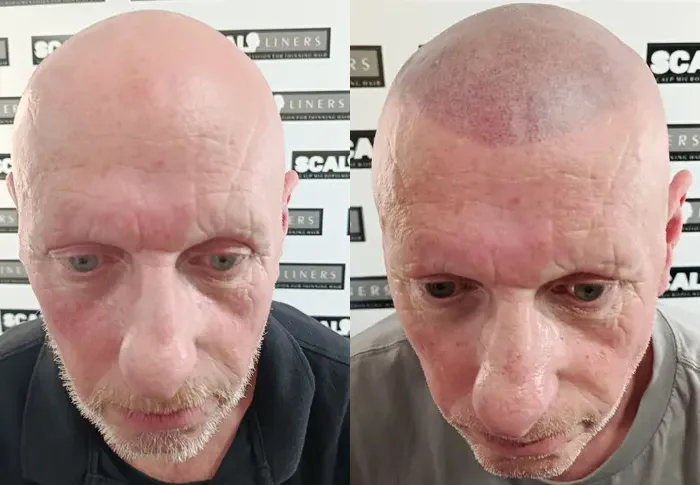
Scalp micropigmentation is a non-surgical cosmetic procedure that uses ultra-fine needles to place specialist pigment into the scalp, replicating the appearance of closely cropped hair follicles. The result is a natural-looking, dense head of stubble or a defined hairline — permanent, zero-maintenance and suitable for any stage of hair loss.
Unlike every other option on this list, SMP:
"I tried finasteride for 18 months. I saw very little change and the side effects weren’t worth continuing. When I discovered SMP I was sceptical — I thought it would look obvious. It doesn’t. My clients tell me the same thing: the result looks completely natural, and they wish they’d done it sooner." — Mark Terrell, ScalpLiners
Most hair loss treatments require you to either buy online and self-administer (finasteride, minoxidil) or travel to London for in-person procedures. ScalpLiners at Whitstable is the only dedicated SMP clinic in the area, serving clients from Canterbury, Maidstone, Chatham, Folkestone, Ashford, Dover, Margate and Ramsgate without the need to travel to the capital.
The clinic is based at 28 Millstream Close, Whitstable, CT5 1RG — easily accessible from the A299, A2 and M2.
There is no perfect solution for male hair loss — but there are clearly better and worse options depending on your circumstances.
If you are in the very early stages of hair loss and are willing to commit to daily medication indefinitely, finasteride is the most evidence-backed pharmaceutical option. If you want to avoid medication entirely and have sufficient donor hair, a quality hair transplant can deliver excellent results — but at significant cost and with a long recovery.
For most men in Kent who want a permanent result with no daily routine, no medication, no recovery period and a fraction of the cost of surgery, SMP is the best-value option available. It is the only treatment that works at every stage of hair loss, is consistent in its results, and requires nothing from you once it’s done.
Common Questions
Based in Whitstable, Serving All of Kent
Mark will give you an honest assessment of every option based on your specific hair loss — including whether SMP is the right choice for you. No upselling. No pressure. From £250 including 3 sessions and a 12-month guarantee.