Understanding Hair Loss
More hair in the shower, clumps on the pillow, a parting that keeps getting wider — hair loss is alarming when it starts. This guide covers every real cause, what each one looks like, and what you can actually do about it. From Mark Terrell at ScalpLiners, who’s been through it himself.
You notice it differently every time. For some people it’s the shower drain — suddenly thick with hair that wasn’t there last month. For others it’s a photograph that catches the light at the wrong angle, or a partner quietly mentioning that your parting looks wider. For some it’s the pillow. For some it’s just running a hand through their hair and feeling something is missing.
Whatever the trigger, the reaction is usually the same: a spike of anxiety, followed by a late-night Google spiral that leaves you more confused than when you started. Hair loss has dozens of potential causes, many of them look similar on the surface, and the internet has a remarkable talent for making every possible scenario sound catastrophic.
So this guide is going to do the opposite. It will tell you clearly what the most common causes are, what each one actually looks like, whether it’s reversible, and what your genuine options are — medical and cosmetic. No alarm, no upsell. Just information.
"I first noticed my hair thinning in my late twenties. I didn’t tell anyone — I just started tilting my phone to avoid certain angles in photos. It took years before I actually understood what was happening and did anything about it. I wish someone had just explained it to me clearly at the start." — Mark Terrell, ScalpLiners
Hair loss is not one thing. There are many different causes, each with a different mechanism, a different appearance, and a different outlook. Here are the most common ones — the ones that account for the overwhelming majority of cases in men and women.
What it looks like: A gradual recession of the hairline at the temples, forming an M-shape, often combined with thinning at the crown. Over time the two areas can merge, leaving only a horseshoe of hair at the sides and back. This follows the well-known Norwood scale from Type I (full hair) to Type VII (minimal coverage).
Who it affects: Men with a genetic sensitivity to dihydrotestosterone (DHT), a hormone derived from testosterone. DHT binds to receptors in follicles on the top and front of the scalp, causing them to miniaturise — producing progressively finer and shorter hairs until they stop growing entirely. The follicles on the sides and back are DHT-resistant, which is why they’re spared. Around 50% of men experience clinically significant hair loss by the age of 50, and for some the process begins in their teens or early 20s.
Is it reversible? No. Once a follicle has fully miniaturised it will not naturally regrow hair. Medications like finasteride (a 5-alpha reductase inhibitor) and minoxidil can slow or temporarily halt the process, and in some cases stimulate modest regrowth. But they require indefinite use and work best on early-stage loss rather than established bald areas. If you’re wondering whether this is what’s happening to you, read our guide: Am I Going Bald? Early Signs and What to Do.
What it looks like: Unlike male pattern baldness, female pattern hair loss (also androgenetic alopecia, but presenting differently due to hormonal differences) typically causes diffuse thinning across the top and crown of the scalp rather than a receding hairline. The parting gradually widens, the scalp becomes more visible through the hair, and overall density reduces. Full baldness is uncommon in women with this condition.
Who it affects: Women of all ages, but increasingly common after the menopause when oestrogen levels fall and androgens become relatively more dominant. Around 40% of women experience noticeable hair thinning by the age of 50. It can also affect younger women, particularly those with polycystic ovary syndrome (PCOS) or other hormonal conditions.
Is it reversible? Generally no, but the progression can often be managed. Minoxidil (available over the counter) is the most commonly used treatment for women and has reasonable evidence behind it. A GP or dermatologist can also investigate hormonal causes and prescribe treatments accordingly. For women whose thinning is stable, scalp micropigmentation can add visible density between existing hairs without creating a shaved-head look.
What it looks like: A sudden, significant increase in hair shedding — often described as coming out in handfuls in the shower or leaving noticeable amounts on the pillow. Unlike pattern baldness it tends to affect the whole scalp rather than following a specific pattern. The hair that falls is usually full-length rather than the miniaturised fine hairs of androgenetic alopecia.
Who it affects: Anyone who has been through significant physical or emotional stress in the past 2–4 months. Common triggers include illness (including COVID-19, which is now well-documented as a cause), major surgery, bereavement, severe psychological stress, extreme crash dieting or dramatic rapid weight loss, childbirth (postpartum hair loss is a form of telogen effluvium), and stopping the contraceptive pill.
The mechanism is that the stressor pushes a large proportion of hairs simultaneously into the telogen (resting/shedding) phase of the hair growth cycle. Normally only 10–15% of hairs are in this phase at any time; in telogen effluvium this can spike to 30% or more, causing diffuse, visible shedding.
Is it reversible? Usually yes. Once the triggering event is resolved, most people see shedding reduce within 3–6 months and regrowth within 6–12 months. However, telogen effluvium can sometimes unmask underlying genetic hair loss that might have remained unnoticed for longer otherwise.
What it looks like: Diffuse shedding similar to telogen effluvium, often without an obvious stress trigger. Can present as increased hair in the drain, general thinning, or hair that feels finer and breaks more easily.
Who it affects: People with low ferritin (stored iron) — particularly common in premenopausal women — are among the most frequently missed cases. Low zinc, vitamin D, B12 and poor overall protein intake have all been linked to increased hair shedding. Crash diets, very low calorie diets, vegan diets without adequate supplementation, and conditions affecting nutrient absorption (coeliac disease, Crohn’s) can all contribute.
Is it reversible? Yes, if the deficiency is identified and corrected. A blood test from your GP can check ferritin, B12, folate, vitamin D, zinc and thyroid function quickly. Correcting a deficiency typically takes 3–6 months to show a meaningful improvement in hair density. This is one of the most important causes to rule out early.
What it looks like: Hair thinning or shedding that is diffuse and often accompanied by other symptoms — fatigue, weight changes, temperature sensitivity (feeling cold or hot), mood changes, dry skin. Both an underactive thyroid (hypothyroidism) and an overactive thyroid (hyperthyroidism) can cause hair loss.
Who it affects: Women more than men, and more commonly in middle age. Autoimmune thyroid conditions (Hashimoto’s, Graves’ disease) are among the most common causes of thyroid dysfunction.
Is it reversible? Hair loss caused by thyroid dysfunction generally improves significantly once the thyroid condition is treated and hormone levels stabilise, though it can take 6–12 months. If you are losing hair alongside any of the other symptoms listed above, a thyroid blood test is essential and should be the first thing you ask your GP for.
What it looks like: Patchy, circular areas of hair loss that appear suddenly, typically on the scalp but can affect eyebrows, beard, eyelashes and body hair. The patches are usually smooth and round. In some people it progresses to alopecia totalis (complete scalp hair loss) or alopecia universalis (total body hair loss), though this is less common.
Who it affects: Alopecia areata is an autoimmune condition — the immune system mistakenly attacks hair follicles. It affects around 2% of the population and can occur at any age, including in children. There is often a genetic predisposition and it can be associated with other autoimmune conditions like thyroid disease.
Is it reversible? Sometimes. Many people with limited patchy alopecia areata see spontaneous regrowth, though recurrence is common. Treatments include topical or injected corticosteroids, topical immunotherapy, and newer JAK inhibitor medications which have shown significant promise in clinical trials. For cases where hair does not regrow or where the psychological impact is significant, SMP for alopecia can provide a stable, confident appearance.
What it looks like: Hair loss accompanied by visible scalp changes — scaling, redness, itching, inflammation or crusting. Common conditions include seborrheic dermatitis (severe dandruff), scalp psoriasis, ringworm (tinea capitis, a fungal infection that can cause patchy loss), and lichen planopilaris (a scarring alopecia that can permanently damage follicles if untreated).
Who it affects: Anyone. Fungal scalp infections are more common in children. Seborrheic dermatitis and psoriasis can occur at any age and are very common.
Is it reversible? Non-scarring scalp conditions (seborrhoeic dermatitis, psoriasis, fungal infections) respond well to treatment and hair loss is typically reversible once the condition is managed. Scarring alopecias (lichen planopilaris, frontal fibrosing alopecia, folliculitis decalvans) can permanently destroy follicles and require prompt diagnosis and treatment to halt progression. If your hair loss involves any scalp changes, see a GP or dermatologist — do not assume it is cosmetic.
What it looks like: Diffuse shedding, often beginning 1–4 months after starting a new medication. The pattern is typically telogen effluvium-like — general thinning rather than patterned loss.
Who it affects: Anyone on medications that can affect the hair growth cycle. Well-documented offenders include certain blood thinners (heparin, warfarin), some antidepressants and mood stabilisers, retinoids, beta-blockers, chemotherapy drugs, and some blood pressure medications. The contraceptive pill can both cause and (when stopped) trigger hair loss depending on the formulation.
Is it reversible? Usually yes, once the medication is adjusted or changed — though this should always be done in consultation with the prescribing doctor. Never stop a prescribed medication for hair loss without medical advice.
This is one of the most important distinctions to make, and one that the internet consistently fails to help with.
See a GP if:
It is most likely cosmetic (androgenetic alopecia) if:
Pattern hair loss does not need medical investigation unless you want to explore medication. A GP is unlikely to be able to do much beyond a basic blood test and a referral to a dermatologist that may take months. Your time is better spent understanding your options.
Once you understand the cause, your options fall into a few clear categories. Here is an honest assessment of each.
Blood tests — If you haven’t had one, start here. Ask your GP for ferritin (not just general iron), B12, folate, vitamin D, zinc, and thyroid function. These can rule out or identify several correctable causes in a single appointment.
Minoxidil — Available over the counter (Regaine is the most well-known brand). Applied topically to the scalp once or twice daily. It works by prolonging the growth phase of the hair cycle and is most effective at maintaining existing hair and slowing loss rather than regrowing significant density. Has reasonable evidence for both male and female pattern loss. Requires indefinite use — stopping reverses any benefit within a few months.
Finasteride — Prescription-only for men. Blocks the conversion of testosterone to DHT, reducing the hormonal attack on follicles. Has strong clinical evidence for slowing and halting male pattern baldness and can produce modest regrowth in some men. Takes 6–12 months to show meaningful results. Must be continued indefinitely. Has a small risk of sexual side effects that reverses on stopping. Not suitable for women who are pregnant or may become pregnant.
Dermatologist referral — For anything that doesn’t fit the typical pattern baldness picture, a dermatologist can perform a scalp biopsy, trichoscopy (scalp magnification) and more sophisticated blood panels to reach an accurate diagnosis. Worth pursuing if your GP cannot explain what’s happening.
Hair transplant — FUE (follicular unit extraction) or FUT (strip) transplants move DHT-resistant donor hair from the back and sides to thinning areas. Can produce natural-looking results for suitable candidates. Costs range from £3,000 to £15,000+ depending on the extent of treatment and the clinic. Requires 12–18 months to see final results, and is not suitable for everyone. Donor supply is limited, and ongoing hair loss means the hairline may continue to recede behind the transplanted area. Many hair transplant patients come to ScalpLiners afterwards for SMP to refine the hairline or conceal the donor scar.
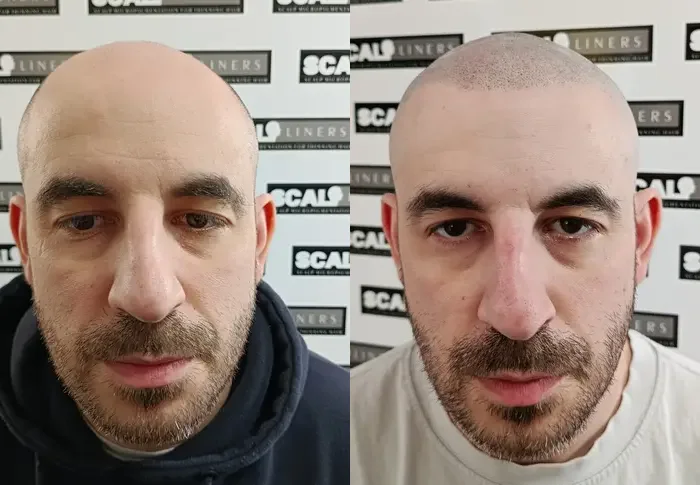
Scalp micropigmentation is fundamentally different from all the above. It does not try to grow hair, slow hair loss or replace follicles. Instead, it deposits specialist pigment into the upper layer of the scalp to replicate the visual appearance of hair follicles — creating the look of a closely cropped, full head of hair regardless of how much natural hair remains.
SMP works at every stage of hair loss — from the first signs of a receding hairline right through to complete baldness. It works whether your hair loss is genetic, caused by alopecia, or the result of a medical condition. It does not depend on follicle health. Results are visible from the first session and the treatment is complete within 3 sessions.
For many people the appeal of SMP is precisely that it removes the uncertainty. You don’t have to wait 12 months to see if a medication worked. You don’t have to hope your hair loss has stabilised before committing. You decide how you want to look, and that’s what you get.
SMP at ScalpLiners starts from £250 including all 3 sessions and a 12-month guarantee. See the full pricing page for details. For those dealing specifically with alopecia, read our dedicated guide: SMP for Alopecia in Kent. For hairline-specific concerns, see SMP for Receding Hairline in Kent.
Prices start from £250 including all 3 sessions and a 12-month guarantee. Message Mark on WhatsApp for a free, no-pressure consultation to discuss what’s right for your specific situation.
It is entirely valid to do nothing. Some men and women decide that hair loss is something they are going to accept, shave their head, and move forward. That takes courage and it is a completely legitimate response. If that’s the direction you want to go in, the guide on going bald covers the practicalities honestly.
But if you are here because you are not at peace with what’s happening — if the hair loss is affecting how you feel in the morning, how you carry yourself in photos, how much mental energy it takes up — then you deserve real information about what can be done. Not false hope. Not expensive products that won’t work. Real options.
The first step is almost always the same: understand what is causing your hair loss before spending money on any treatment. If it might be medical, get a blood test. If it’s clearly genetic and progressive, understand your medical options and your cosmetic options side by side.
At ScalpLiners, the free consultation with Mark is exactly that — a straight conversation. He will not push SMP on someone who should be seeing a doctor first. He will not promise regrowth that isn’t coming. He will tell you honestly where you are, what your options are, and what he would do in your situation. That is what his own experience taught him to value.
If you have more questions about hair loss, the ScalpLiners FAQ covers many of the most common ones in detail. And if you want to talk it through, a WhatsApp message costs nothing and takes thirty seconds.
Common Questions
Get a Clear Answer
Mark has been through hair loss himself. He will give you an honest assessment of what’s happening, what your options are, and what he would do in your position — whether that’s SMP, medication, a GP visit, or a combination. No pressure, no upselling. SMP from £250 including 3 sessions and a 12-month guarantee.