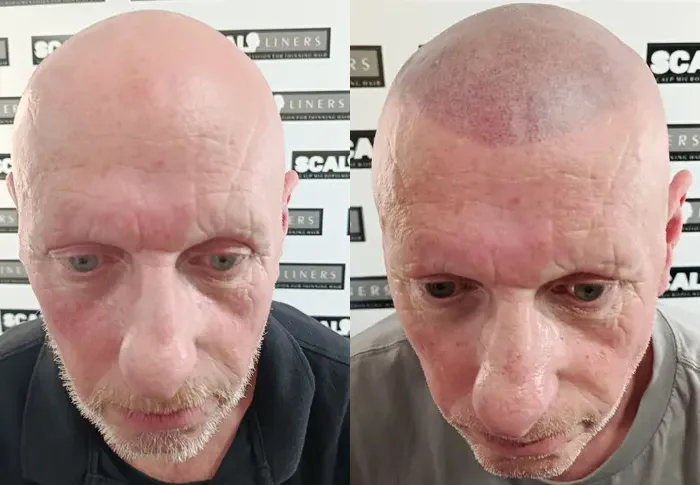
In-Depth Comparison
Mark Terrell has had SMP himself and has worked with clients who’ve come from failed or incomplete transplants. This article goes beyond the surface — covering real decision-making factors including what happens when a transplant doesn’t deliver, and why many men end up combining both.
If you’ve been researching hair loss solutions for any length of time, you’ve probably seen the marketing for both. Hair transplant clinics show lush before-and-afters of men with full heads of hair. SMP clinics show clean, shaved-look results that seem almost too sharp to be real. Both look compelling. Both feel permanent. And the price difference is so enormous that it can feel like one must be a compromise.
It isn’t that simple. The right choice depends entirely on your hair loss stage, your budget, your lifestyle, your tolerance for surgical recovery — and critically, whether you even qualify for a transplant in the first place. This article gives you the honest breakdown, written from first-hand experience of both sides.
"I had SMP before I trained as a practitioner. I spent years looking at hair transplants first. The cost, the recovery, the uncertainty of graft survival — I kept coming back to SMP. I wanted something that worked immediately, looked natural and didn’t carry surgical risk. That’s still what I tell every client who walks through the door." — Mark Terrell, ScalpLiners
Before diving into the detail, here is a complete side-by-side of the factors that matter most when making this decision.
| Factor | Scalp Micropigmentation (SMP) | Hair Transplant (FUE / FUT) |
|---|---|---|
| Cost (UK) | From £250 — full treatment £250–£1,200 | £3,000–£15,000 depending on graft count |
| Pain level | 2–3/10 with topical numbing cream | 5–7/10 with local anaesthetic injections + post-op soreness |
| Recovery time | Back to work next day, no downtime | 1–2 weeks off, 4 weeks before full activity |
| When results show | Visible from session 1; complete after session 3 | 6–12 months for full growth |
| Maintenance | Top-up every 3–7 years, minimal daily upkeep | Ongoing medication, possible further transplants |
| Scarring | None | FUE dot scars; FUT linear strip scar |
| Suitable for | All hair loss stages, alopecia, women, scars | Requires sufficient donor hair — not all qualify |
| Risk of poor outcome | Very low — 12-month guarantee at ScalpLiners | Graft survival 70–90%; some may need repeat procedure |
| Longevity | 3–7 years before top-up needed | Transplanted follicles are permanent but native hair thins |
| Can be combined with the other? | Yes — SMP often follows a transplant to add density and hide scars | Yes — some clients do transplant then SMP, or vice versa |
The headline price of a hair transplant — say, £4,500 for a mid-range FUE in the UK — is rarely the total you end up spending. Here is what the true cost picture often looks like over a decade:
Over ten years, many transplant patients spend £15,000–£25,000 in total. SMP at ScalpLiners — including a top-up session at year five or six — costs most clients under £2,000 over the same period. That is not a minor difference.
It is also worth noting the Turkish transplant clinic risk. Procedures priced at £1,500–£3,000 with flights and hotels included carry real risks: inconsistent quality control, no regulated aftercare, and no legal recourse if the result is poor. Several ScalpLiners clients have come in specifically to repair the aftermath of Turkish procedures.
SMP uses ultra-fine microneedles penetrating only the upper dermis. With a topical numbing cream applied beforehand, most clients rate the sensation at 2–3 out of 10. The feeling is a light, repetitive tapping — not sharp, not cutting. Sessions run 3–4 hours, breaks are available at any point, and you walk out the same day looking like you’ve freshly shaved your head.
A hair transplant is a surgical procedure. Local anaesthetic is injected into the scalp — and the injections themselves are often described as the most unpleasant part. The surgery lasts 6–10 hours for larger graft counts. Post-operatively, the scalp is swollen, crusted and tender for 1–2 weeks. Most transplant clinics recommend at least two weeks off work. Physical exercise, alcohol, sun exposure and any scalp pressure (including wearing a hat) are restricted for four weeks or more.
To be clear: Mark isn’t anti-transplant. If you want to grow real hair, have strong donor density at the back and sides of your scalp, have the budget for a reputable UK clinic, and are prepared for a 6–12 month wait before the result is visible — then a transplant is worth researching properly. It is a legitimate solution with good results when the right conditions are met.
Where it does not make sense: advanced Norwood 6–7 hair loss (insufficient donor hair), diffuse thinning across the entire scalp (poor donor area), anyone with a limited budget, or anyone who cannot afford the downtime. In all of these cases, SMP delivers a better outcome for the individual’s situation.
This is the section that most hair loss websites skip over. The reality is that hair transplants do not always deliver the expected density. Graft survival rates are typically quoted at 70–90%, but uneven growth, incorrect angulation of implanted follicles, or insufficient graft coverage can leave a result that looks thin and patchy rather than full.
When that happens, clients have a limited number of options. Further surgery is possible if donor supply allows, but many are already stretched. This is where SMP becomes extraordinarily valuable as a rescue treatment. Pigment deposited in the recipient area — precisely between the transplanted hairs — creates the visual impression of density that the transplant itself failed to produce. The result looks full, natural and complete, without any further surgery.
Equally important: both FUE and FUT procedures leave scars in the donor zone. FUE leaves a field of small, round white punch marks across the back and sides. FUT leaves a single horizontal linear scar. Both become visible when the hair is cut short — a problem that many clients don’t anticipate until they’re already committed. SMP applied to those scars blends them into the surrounding scalp so effectively that they become invisible at any length above a grade 1.
"About a third of my new clients are coming from transplants — either to add density to an underwhelming result, or to hide the donor scars. I always tell them: SMP and transplants aren’t competing treatments. For a lot of men, they’re part of the same journey." — Mark Terrell
Hair transplants are often sold as a one-time permanent fix. In reality, the transplanted hair itself is permanent, but the native hair around it continues to thin. Without ongoing medication — typically finasteride and/or minoxidil — the surrounding hair recedes, creating an increasingly patchy contrast between the transplanted area and the rest of the scalp. For many men this means either committing to medication indefinitely (with associated cost and potential side effects) or undergoing further transplants.
SMP requires no daily maintenance. The shaved-head look it creates means you simply keep your natural hair trimmed to grade 0–1, which blends seamlessly with the pigment. No products. No sprays. No powders. No pills. A top-up session at year 3–7 refreshes the pigment as it fades naturally, and costs a fraction of the original treatment.
If you want to grow real hair, qualify for a transplant, have the budget and can handle the recovery — a transplant may be the right path. Consider SMP afterwards to maximise density and protect the donor zone.
If you want an immediate, permanent-looking result with zero surgery, zero downtime, and a fraction of the cost — SMP is the better choice for most men dealing with hair loss in 2025. The clean, shaved-head look it creates is not a compromise. For the majority of ScalpLiners clients, it is the definitive answer they’d been searching for.
The best starting point is a free consultation. Send Mark a photo of your current hair on WhatsApp and he’ll give you an honest assessment — including whether a transplant is worth considering in your specific case, or whether SMP alone would give you the result you’re looking for.
Common Questions
Get a Free Honest Opinion
WhatsApp a photo of your hair and Mark will give you a straight answer. He’s had SMP himself and has helped clients navigate the transplant question many times. Free, no pressure, no obligation. Call 07549 402913.
Keep Reading