How to Fix a Receding Hairline Without Surgery

A receding hairline affects more than just the way you look. This guide covers every non-surgical option honestly — from medications and PRP to scalp micropigmentation — so you can make an informed decision about what will actually work for you.

Free WhatsApp Consultation See Pricing From £250

It Is Not Just About Hair

Most men who contact ScalpLiners about a receding hairline are not primarily thinking about aesthetics when they get in touch. They’re thinking about the way a colleague made a comment at work and they couldn’t shake it. They’re thinking about how they position themselves in photos. They’re thinking about how they looked at twenty-five versus the reflection they see now. They’re thinking about how a hairline that has moved back two centimetres seems to have added ten years to their face overnight.

Hair loss — even partial hair loss limited to the hairline — has a well-documented impact on self-confidence. Studies consistently show that men who perceive themselves as prematurely balding report lower confidence in social and professional settings. None of this is vanity. It is a genuine psychological response to a change in appearance that feels out of your control.

The good news is that it does not have to stay that way. And you do not need surgery to fix it.

Understanding What Is Actually Happening

In the vast majority of cases, a receding hairline is caused by androgenetic alopecia — male pattern hair loss — driven by a sensitivity to dihydrotestosterone (DHT). Over time, DHT miniaturises the hair follicles at the temples and frontal hairline, causing them to produce thinner, shorter hairs before eventually ceasing production altogether. Once a follicle is fully miniaturised and dormant, it cannot be reactivated by topical or oral treatments alone.

This matters because it defines which treatments can actually help. If you catch recession early — at Norwood 1–2 — some medical treatments can genuinely slow or partially reverse the process. If the recession is more advanced, the focus shifts from regrowth to restoration: recreating the appearance of a defined hairline rather than regrowing hair that is no longer there.

Option 1: Finasteride (Propecia)

Finasteride is an oral medication that works by blocking the enzyme responsible for converting testosterone into DHT. Taken daily at 1mg, it reduces DHT levels in the scalp by approximately 60–70%, which is enough to slow or halt further miniaturisation in most men. Around 80% of men who take finasteride see their hair loss stabilise. Around 30–40% see some degree of regrowth, particularly in the crown.

The limitations: Finasteride only works while you take it. Stop taking it and hair loss resumes, often rapidly. It takes 6–12 months before any benefit is visible. It is not effective at regrowing a hairline once the follicles are significantly miniaturised. A small percentage of men (estimated 1–3%) experience side effects including reduced libido and erectile dysfunction, though these are reversible on discontinuation. It also costs £25–£60 per month indefinitely.

Finasteride is a reasonable choice for men in the early stages of recession who want to slow the process. It is not a complete solution for men already dealing with significant hairline loss.

Option 2: Minoxidil

Minoxidil is a topical (or oral) treatment that stimulates blood flow to hair follicles and prolongs the growth phase of the hair cycle. It is available over the counter as a 2% or 5% solution or foam and is applied directly to the scalp. Oral minoxidil at low doses (0.5–2.5mg) has become increasingly popular as a more systemic option.

The limitations: Minoxidil is most effective at the crown, less so at the hairline. Results require consistent twice-daily application. Stopping minoxidil causes a shedding phase as the treatment-dependent hairs return to their natural cycle. Like finasteride, it is a maintenance treatment, not a permanent fix. It also does not create a defined hairline — it may reduce the rate of thinning, but cannot restore a hairline that has already moved back.

Option 3: PRP (Platelet-Rich Plasma) Therapy

PRP treatment involves drawing a small amount of the patient’s own blood, processing it to concentrate the growth factors, and injecting it into the scalp to stimulate follicle activity. The evidence base is growing and reasonably encouraging for men in early-stage hair loss with sufficient follicular activity remaining.

The limitations: PRP works best as a maintenance treatment rather than a restoration solution. It requires multiple sessions (typically 3–4 initially, then quarterly or bi-annual top-ups), each costing £200–£500. The injections are uncomfortable. Results are inconsistent between individuals. It cannot create a new hairline — only potentially stimulate follicles that are still partially active. For men with moderate to advanced recession, the practical impact is limited.

Option 4: Hairpieces and Hair Systems

Modern hair systems have come a long way from the toupees of popular mythology. High-quality hair replacement systems can look remarkably convincing in ideal conditions. Some men find them a satisfactory solution.

The limitations: A quality hair system costs £500–£3,000 and needs replacing every 3–6 months, creating an ongoing cost of £1,000–£6,000+ per year. Adhesive bonding limits swimming, vigorous exercise and intimacy. Maintenance is daily. Many wearers describe significant anxiety about the system shifting, being discovered, or not passing close scrutiny. It is a daily commitment, not a solution.

Option 5: Scalp Micropigmentation — Permanent Hairline Restoration from £250

Scalp micropigmentation is the only non-surgical treatment that permanently restores the visual appearance of a defined hairline — regardless of how far it has receded.

The process works by depositing specialist pigment into the upper dermis of the scalp in tiny, precise dots that replicate the appearance of shaved hair follicles. When applied along the hairline, SMP creates a sharp, natural-looking boundary that frames the face in exactly the same way a natural hairline does. The recession is no longer visible. The age the hairline was adding to your face is gone.

"My hairline had been receding since my mid-twenties. I tried the comb-forward. I tried the products. I watched my confidence leave with the hair. The day after my first SMP session, I walked into work differently. I’m not exaggerating. That shift in confidence is real, and it happens immediately." — Mark Terrell, ScalpLiners

What SMP for a Receding Hairline Actually Looks Like

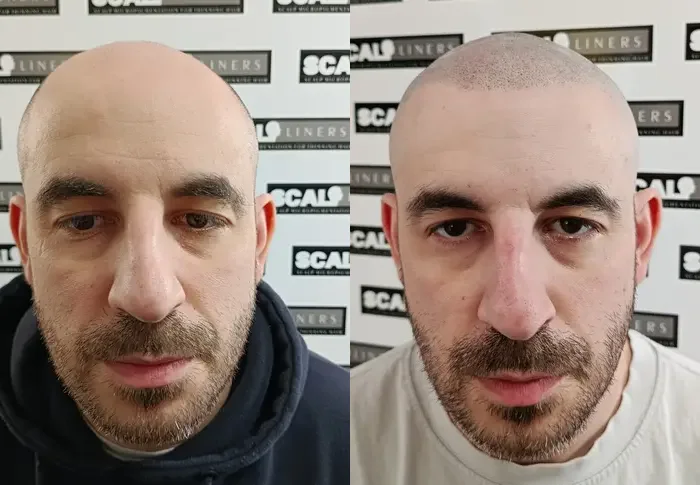
Before treatment: a client arrives with a hairline that has moved back at the temples, creating the characteristic M-shape or widow’s peak associated with Norwood 2–3 recession. The scalp at the temples is visible. The transition from hair to scalp is soft and unflattering.

During the consultation: Mark discusses the target hairline shape, drawing it with reference to the client’s face shape, bone structure, age and natural hair characteristics. A hairline that looks age-appropriate at forty is different from one designed for a twenty-five-year-old. This bespoke design stage is where the natural result is won or lost.

After session 1: the new hairline is visible. The temples are filled in. The M-shape is gone. The face looks more balanced and the overall appearance is of someone who shaves their head by choice rather than necessity. The result is visible from the first day.

After session 3: the hairline is complete. Pigment density is built up over multiple sessions for a result that holds depth and dimension rather than looking flat. The 12-month guarantee at ScalpLiners means that if anything fades unexpectedly in the first year, it is corrected at no additional cost.

Who SMP for a Receding Hairline Is Best For

Ideal Candidates

  • Men at any stage of hairline recession
  • Men who want an immediate visible result
  • Anyone who prefers the shaved / close-cropped look
  • Men who have tried medications without satisfaction
  • Anyone who wants zero daily maintenance
  • Men who cannot afford or don’t qualify for a transplant

Key Advantages Over Other Options

  • Results visible after session 1
  • No surgery, no needles in the scalp, no anaesthetic injections
  • No daily maintenance products or application
  • Works regardless of how far hairline has receded
  • From £250 — fraction of transplant cost
  • 12-month guarantee at ScalpLiners

The Maintenance Reality: SMP vs Everything Else

One of the most overlooked advantages of SMP for hairline restoration is what it does not require. Finasteride and minoxidil are daily medications taken indefinitely. PRP requires quarterly clinic visits. Hair systems require daily adhesive application, cleaning, and regular replacement. Every other treatment demands something from you every single day.

SMP requires nothing between sessions. Keep your natural hair trimmed short so it blends with the pigment, and that is it. No products. No pills. No anxiety about whether your solution is holding up. A top-up session at year 3–7 is all that is needed to refresh the result as the pigment fades naturally over time. For most clients, this represents a total 10-year cost of under £2,000 — dramatically less than any of the alternatives when compared honestly over the same period.

Why the Hairline Design Matters More Than Anything

The difference between SMP that looks natural and SMP that looks artificial is almost entirely down to hairline design. A hairline that is placed too low, too straight, or too sharp will look artificial regardless of how well the pigment is applied. This is the most technically demanding aspect of the treatment and the area where practitioner experience matters most.

Mark designs every hairline individually. He takes into account the natural shape of the forehead, the bone structure, the client’s age and the way hair naturally grows — with micro-irregularities along the edge rather than a perfectly geometric line. The result should look like a hairline that has always been there, not like one that has been drawn on. This bespoke approach is included as standard at ScalpLiners, not charged as an extra.

Getting Started: What to Expect

The simplest first step is a free WhatsApp consultation. Send Mark a clear photo of your hairline and he will give you an honest assessment of what SMP can achieve in your specific case, along with an indicative cost. There is no obligation and no sales pressure. If SMP is not the right solution for your situation, he will tell you that too.

Treatment takes place at the ScalpLiners clinic at 28 Millstream Close, Whitstable — serving clients across Kent including Canterbury, Maidstone, Ashford, Chatham, Folkestone and beyond. Most clients travel specifically for the level of care and personalised approach that a specialist single-practitioner clinic provides.

The full hairline treatment takes 2–3 sessions of approximately 3–4 hours each, spaced 2–4 weeks apart. Prices start from £250 with 47 five-star reviews and a 12-month guarantee on all work.

Receding Hairline — Your Questions Answered

Can a receding hairline be restored without surgery?
Yes. While no non-surgical treatment can regrow a receding hairline once the follicles are gone, scalp micropigmentation (SMP) creates the permanent visual appearance of a full, defined hairline without any surgery. The result is indistinguishable from a naturally shaved head with a sharp hairline. Medications like finasteride can slow further recession if started early enough.
How much does SMP for a receding hairline cost in the UK?
At ScalpLiners in Whitstable, Kent, a receding hairline treatment starts from £250. This includes your bespoke hairline design, 2–3 sessions and a 12-month guarantee. The exact price depends on how far the hairline has receded and how much scalp needs to be treated.
Does scalp micropigmentation for a hairline look natural?
Yes — when performed by an experienced specialist. Mark at ScalpLiners designs each hairline individually, taking into account face shape, skin tone, age and the client’s natural hair characteristics. The result is a soft, realistic hairline that looks like it has always been there — not a drawn-on line.
Is SMP for a receding hairline permanent?
SMP is considered a long-term permanent treatment. The pigment fades gradually over 3–7 years as a natural response to UV exposure and skin cell turnover. A top-up session restores the original result. Unlike hairpieces or concealers, there is no daily maintenance required between treatments.

Free Consultation — Send Mark a Photo on WhatsApp

Send a photo of your hairline on WhatsApp and Mark will give you an honest assessment of what SMP can achieve, along with a no-obligation cost estimate. 47 five-star reviews. Prices from £250 including 3 sessions and a 12-month guarantee. Call 07549 402913.

Free WhatsApp Consultation See Full Pricing

Related Articles

SMP vs Hair Transplant

An honest in-depth comparison of cost, pain and results

Does SMP Hurt?

Honest pain guide from a practitioner who has had it himself

Is SMP Permanent?

How long does scalp micropigmentation really last?

Hairline SMP Service

ScalpLiners’ receding hairline service in Kent

SL
ScalpLiners Assistant● Online — replies instantly