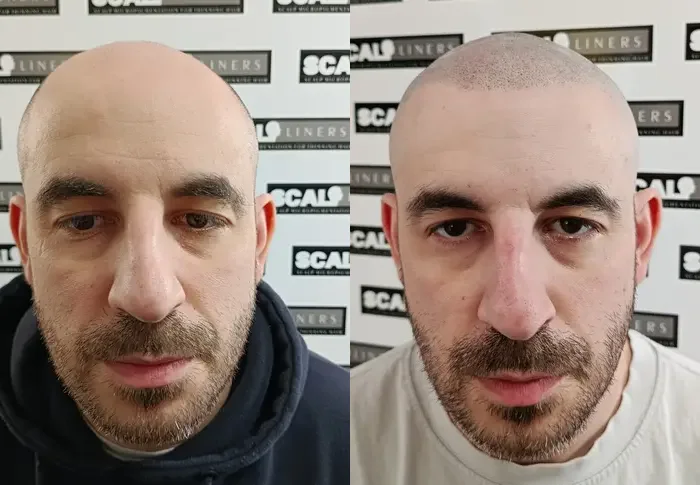
Scar Camouflage Guide
Whether you have FUE dot scars across the donor area or an FUT strip scar along the back of your head — SMP can hide it. Here is exactly how it works, what to expect, and what real results look like from a Kent clinic that treats this every week.
A hair transplant is sold as the permanent fix. And for many men, it delivers — a fuller hairline, more confidence, a look they’re happy with. But there’s a detail most clinics don’t mention loudly enough before you go under the needle: the scarring.
FUE (follicular unit extraction) leaves dozens or even hundreds of tiny circular punch scars across the donor area at the back and sides of the head. FUT (follicular unit transplant, also called the strip method) leaves a horizontal linear scar that can run ear to ear. At longer hair lengths these are usually hidden. But keep your hair shorter than a grade 3 or 4 — and they become visible. White dots. A pale line. A reminder of the procedure that was supposed to fix things.
This is one of the most common reasons people contact ScalpLiners. Not because the transplant failed entirely — but because the scarring is stopping them from wearing their hair the way they actually want to.
"Most of my scar camouflage clients have already had a transplant. They just want to be able to cut their hair short without worrying about what’s visible at the back. SMP is the most effective way to do that — and in most cases the result is undetectable." — Mark Terrell, ScalpLiners
Scalp micropigmentation works by depositing tiny dots of medical-grade pigment into the scalp using a fine needle. When applied to scar tissue, the technique is adapted slightly — scar tissue behaves differently to normal skin, with less porosity and different pigment retention characteristics. An experienced practitioner knows how to work with this.
The pigment is matched precisely to your natural follicle colour and deposited both inside the scar and along its edges. The goal is to eliminate the colour contrast between the scar and the surrounding scalp, making the scar invisible at normal viewing distance. It is not about covering the scar with a flat block of colour — it is about replicating the texture and tone of the follicle pattern around it so the eye cannot distinguish the treated area from the rest of the scalp.
FUE scars appear as small circular white or pale dots scattered across the donor zone. Each one corresponds to a follicular extraction point. They range in size from barely visible to a few millimetres depending on the punch tool used and how the skin healed.
At grade 1 or 2 clipped hair, these dots can be surprisingly visible — particularly in strong light or if the surrounding scalp is tanned. Many clients find they cannot comfortably wear their hair any shorter than a grade 4 after a FUE transplant, which defeats the purpose if they wanted a close-cropped look.
SMP fills each dot with a pigment deposit that matches the natural hair colour. Because the dots are the same circular shape as natural follicle impressions, the camouflage is particularly effective. After 2–3 sessions, most clients find their FUE donor area is indistinguishable from a naturally shaved scalp.
The FUT (strip) scar is a more significant challenge — a horizontal line running across the occipital area that can vary from a few centimetres to the full width of the head. It is often pale, slightly raised, and clearly visible at shorter hair lengths.
SMP camouflages the strip scar by depositing pigment directly into the scar tissue to match its tone to the surrounding scalp, then adding follicle-impression dots along the length of the scar and blending outward. The linear shape of the scar is broken up visually so the eye no longer reads it as a single continuous line.
Strip scar work often requires 3 sessions to build sufficient density and consistency within the scar tissue. The end result — in the hands of a skilled practitioner — is a donor area that can be worn at grade 1 without the scar being visible.
Important
Scar tissue retains pigment differently to normal scalp. Results can be slightly less predictable than standard SMP, which is why multiple sessions and an experienced practitioner matter. At ScalpLiners, every scar camouflage treatment comes with a 12-month guarantee — if the result isn’t right, we correct it at no additional cost.
For most clients, scar camouflage SMP takes 2 to 3 sessions. The first session establishes coverage and tests how the scar tissue responds to the pigment. The second session adds density and refines the tone match. A third session may be needed for larger or more complex scars, or where the scar tissue has absorbed pigment unevenly in the first round.
Sessions are spaced 10 to 14 days apart to allow the skin to heal and for the true settled pigment colour to be assessed before the next session. Rushing this process produces worse results — any practitioner suggesting you can complete scar camouflage in a single session should be treated with caution.
Scar camouflage SMP is suitable for anyone with visible hair transplant scarring — FUE, FUT, or a combination of both. It is also suitable for scars from other causes, including accidents, surgery, alopecia, and traction-related hair loss. There is no minimum or maximum age, and the treatment works equally well on men and women.
The main qualifier is that the scar must be fully healed before treatment begins. For hair transplant scars, most practitioners recommend waiting at least 12 months after the procedure before starting SMP work.
| Scar Type | Sessions Typically Needed | Expected Result |
|---|---|---|
| FUE dot scars | 2–3 sessions | Virtually undetectable at grade 1–2 |
| FUT strip scar (small) | 2–3 sessions | Line broken up, blend at short length |
| FUT strip scar (wide or raised) | 3 sessions | Significant improvement — may not be fully invisible at grade 0 |
| Combined FUE + FUT scarring | 3 sessions | Both areas treated, full donor zone blend |
| Accident or surgery scars | 2–3 sessions | Highly variable — assessed case by case |
Many clients who come in for scar camouflage also have thinning or balding across the top. It makes sense to treat both at the same time — the scar is hidden in the donor area and a full shaved-head or density look is recreated across the crown. This combined approach is the most common treatment at ScalpLiners for post-transplant clients.
The pricing for a combined full-head SMP and scar camouflage is worked out based on the overall area, and is always confirmed in a free WhatsApp consultation before you commit to anything.
Scar tissue can be more sensitive than normal scalp, but the treatment uses a topical numbing cream applied 45 minutes before the session begins. Most clients rate the discomfort at 2–3 out of 10 — comparable to a light scratch. The donor area at the back of the head tends to be less sensitive than the hairline or crown. Sessions typically last 2–4 hours depending on the area being treated.
SMP scar camouflage fades at roughly the same rate as standard SMP — gradually over 3 to 7 years, depending on skin type, sun exposure and lifestyle. A single top-up session restores the result when fading is noticeable. Because scar tissue can retain pigment differently, some clients find their scar camouflage top-up is needed slightly sooner than their surrounding SMP. This is assessed at each annual check-in.
ScalpLiners is a dedicated SMP-only clinic in Whitstable, Kent — not a general aesthetics salon offering SMP as a side service. Mark Terrell has had SMP himself and works exclusively on scalp treatments. All work comes with a 12-month guarantee and a free WhatsApp consultation before you make any decision.
If you are in Kent — Whitstable, Herne Bay, Canterbury, Medway, Maidstone, Ashford, Folkestone, Dover, Thanet or anywhere across the county — scar camouflage SMP at ScalpLiners is available without a lengthy waiting list. Most clients are seen within 2 to 3 weeks of their initial enquiry.
Ready to Find Out More?
Mark will assess your scar photos directly and give you an honest view of what SMP can achieve for your specific scarring — before you commit to anything. No obligation. No sales pressure.
WhatsApp Mark NowYes. SMP is widely regarded as the most effective non-surgical solution for camouflaging both FUE dot scars and FUT linear strip scars. Pigment is deposited into and around the scar tissue to match the surrounding scalp, making the scar virtually invisible at normal viewing distance.
Most scar camouflage cases take 2 to 3 sessions. Scar tissue is less porous than normal scalp, so pigment retention can vary — a second and third session builds density and ensures even coverage. Sessions are spaced 10 to 14 days apart.
Yes. FUT leaves a horizontal linear scar across the back of the head. SMP applies tiny pigment deposits into the scar tissue and along its edges to break up the line and blend it with the surrounding scalp. Results are highly effective, particularly for clients who wear their hair short.
Yes. FUE leaves small circular punch scars across the donor area. These show as white dots at short hair lengths. SMP fills the dots with pigment matching the natural follicle colour, making them blend seamlessly with the rest of the scalp.
At ScalpLiners in Whitstable, Kent, scar camouflage SMP starts from £250 for a single session and typically ranges from £400 to £900 for full treatment across multiple sessions, depending on the size and complexity of the scarring. A free WhatsApp consultation is available before any commitment. See full SMP pricing here.
When carried out by an experienced practitioner, yes. The key is matching the pigment tone precisely to the client’s natural follicle colour and working within and around the scar tissue. ScalpLiners has a 12-month guarantee on all treatments, including scar camouflage work.
Related reading: SMP Scar Camouflage Kent — SMP vs Hair Transplant — SMP Pricing — About ScalpLiners
ScalpLiners — Whitstable, Kent
Every scar camouflage treatment at ScalpLiners is backed by a 12-month guarantee. If the result isn’t right, Mark corrects it at no additional cost. Start with a free WhatsApp assessment — photos welcome.